

Updated Aug 18, 2026 HPE6-A85 Exam Dumps - PDF Questions and Testing Engine
New (2026) HP HPE6-A85 Exam Dumps
NEW QUESTION # 14
You need to configure wireless access for several classes of loT devices, some of which operate only with 802 11b. Each class must have a unique PSK and will require a different security policy applied as a role. There will be 15-20 different classes of devices and performance should be optimized. Which option fulfills these requirements?
- A. Single SSID with MPSK for each loT class using 5 GHz and 6 GHz bands
- B. Individual SSIDs with unique PSK for each loT class, using 2.4GHZ and 5GHz band
- C. Individual SSIDs with unique PSK for each loT class, using 5 GHz and 6 GHz bands
- D. Single SSID with MPSK for each loT class using 2.4GHz and 5 GHz bands
Answer: D
Explanation:
A single SSID with MPSK supports many device-specific or group-specific passphrases and can map each IoT class to the appropriate role-based security policy. Using 2.4 GHz is required for
802.11b-only devices, while 5 GHz helps optimize performance for capable clients.
NEW QUESTION # 15
Which authentication does HPE Aruba Networking's Captive Portal use?
- A. Layer 3 authentication
- B. MAC authentication
- C. 802.1x authentication
- D. Layer 2 authentication
Answer: A
Explanation:
Aruba's Captive Portal uses Layer 3 authentication, which means that it intercepts the client's HTTP requests and redirects them to a web page where the client can enter their credentials. The credentials are then verified by a RADIUS server or a local database before granting network access.
NEW QUESTION # 16
What are two characteristics of HPE Aruba Networking ClientMatch? (Choose two.)
- A. It is used to locate a client.
- B. It helps to move sticky clients to another AP.
- C. An algorithm to adjust RF patterns.
- D. It is an HPE Aruba Networking patented technology.
- E. It optimizes channels of an AP.
Answer: B,D
Explanation:
ClientMatch is an Aruba patented technology that helps to move sticky clients--clients that stay connected to an AP even when there are better APs available--to a more appropriate AP. This technology ensures that clients are always connected to the best available AP, optimizing both the client's performance and the overall performance of the wireless network.
NEW QUESTION # 17
A network technician has successfully connected to the employee SSID via 802 1X Which RADIUS message should you look for to ensure a successful connection?
- A. Authorized
- B. Authenticated
- C. Success
- D. Access-Accept
Answer: D
Explanation:
Explanation
The RADIUS message that you should look for to ensure a successful connection via 802.1X is Access-Accept. This message indicates that the RADIUS server has authenticated and authorized the supplicant (the device that wants to access thenetwork) and has granted it access to the network resources. The Access-Accept message may also contain additional attributes such as VLAN ID, session timeout, or filter ID that specify how the authenticator (the device that controls access to the network, such as a switch) should treat the supplicant's traffic.
The other options are not RADIUS messages because:
Authorized: This is not a RADIUS message, but a state that indicates that a port on an authenticator is allowed to pass traffic from a supplicant after successful authentication and authorization.
Success: This is not a RADIUS message, but a status that indicates that an EAP Extensible Authentication Protocol (EAP) is an authentication framework that provides support for multiple authentication methods, such as passwords, certificates, tokens, or biometrics. EAP is used in wireless networks and point-to-point connections to provide secure authentication between a supplicant (a device that wants to access the network) and an authentication server (a device that verifies the credentials of the supplicant). exchange has completed successfully between a supplicant and an authentication server.
Authenticated: This is not a RADIUS message, but a state that indicates that a port on an authenticator has received an EAP-Success message from an authentication server after successful authentication of a supplicant.
References: https://en.wikipedia.org/wiki/RADIUS#Access-Accept
https://www.cisco.com/c/en/us/support/docs/security-vpn/remote-authentication-dial-user-service-radius/13838-1
https://en.wikipedia.org/wiki/IEEE_802.1X#Port-based_network_access_control
https://en.wikipedia.org/wiki/Extensible_Authentication_Protocol#EAP_exchange
NEW QUESTION # 18
Where are wireless client roaming decisions made?
- A. Joint decision made by the origination and destination APs
- B. Aruba Central
- C. Virtual Controller
- D. Client device
Answer: D
Explanation:
Wireless client roaming decisions are made by the client device based on its own criteria, such as signal strength, noise level, data rate, etc. The network can influence the client's roaming decision by providing information such as neighbor reports, load balancing, band steering, etc., but the final decision is up to the client. Reference: https://www.arubanetworks.com/techdocs/Instant_86_WebHelp/Content/instant-ug/wlan-roaming/client-roaming.htm Wireless client roaming decisions are primarily made by the client device itself. The client device monitors the signal strength and quality of the current connection and decides to roam to a different Access Point (AP) when the current signal deteriorates below a certain threshold or a better option is available. While APs and controllers can provide information and support for roaming decisions through protocols like 802.11k and 802.11v, the ultimate decision to roam is made by the client device based on its algorithms and thresholds.
NEW QUESTION # 19
When performing live firmware upgrades on Aruba APs.
Which technology partitions all the APs based on RF neighborhood data minimizing the impact on clients?
- A. HPE Aruba Networking ESP
- B. HPE Aruba Networking ClientMatch
- C. HPE Aruba Networking AirMatch
- D. HPE Aruba Networking AI Insights
Answer: C
Explanation:
Aruba AirMatch is a feature that optimizes RF Radio Frequency. RF is any frequency within the electromagnetic spectrum associated with radio wave propagation. When an RF current is supplied to an antenna, an electromagnetic field is created that then is able to propagate through space. performance and user experience by using machine learning algorithms and historical data to dynamically adjust AP power levels, channel assignments, and channel width. AirMatch performs live firmware upgrades on Aruba APs by partitioning all the APs based on RFneighborhood data and minimizing the impact on clients. AirMatch uses a rolling upgrade process that upgrades one partition at a time while ensuring that adjacent partitions are not upgraded simultaneously.
NEW QUESTION # 20
What is indicated by a solid amber radio status LED on an Aruba AP?
- A. The radio is working the 5 GHz band only.
- B. Not enough PoE is provided from the switch to power both radios of the AP
- C. The radio is working in mesh mode
- D. The radio is enabled in monitor or spectrum analysis mode
Answer: D
Explanation:
Explanation
The solid amber radio status LED on an Aruba AP Access Point (AP) Access Point (AP) is a device that connects wireless devices to a wired network using Wi-Fi or other wireless standards . APs act as transmitters and receivers of wireless signals and provide wireless coverage for a specific area . APs can operate in different modes such as root , repeater , bridge , mesh , etc . APs can also support different features such as security , QoS , roaming , load balancing , etc . APs can be standalone devices or managed by controllers or cloud services . APs can be verified by using commands such as show ap active , show ap database , show ap bss-table , etc . indicates that the radio is enabled in monitor or spectrum analysis mode. Monitor mode is a mode that allows the AP to scan all channels and collect information about wireless traffic, interference, rogue devices, etc. Spectrum analysis mode is a mode that allows the AP to scan all channels and collect information about RF Radio Frequency (RF) Radio Frequency (RF) is a term that refers to electromagnetic waves that have frequencies between 3 kHz and 300 GHz . RF waves are used for various purposes such as communication , broadcasting , radar , navigation , remote control , etc . RF waves can be modulated by changing their amplitude , frequency , or phase to encode information . RF waves can also be affected by various factors such as attenuation , reflection , refraction , diffraction , scattering , interference , noise , etc . RF waves can be measured by using devices such as spectrum analyzers , power meters , antennas , etc . environment, noise sources, channel utilization, etc. Both modes are useful for troubleshooting and optimizing wireless performance, but they disable normal data transmission and reception on the radio.
The other options are not indicated by a solid amber radio status LED on an Aruba AP because:
Not enough PoE is provided from the switch to power both radios of the AP: This option is false because not enough PoE Power over Ethernet (PoE) Power over Ethernet (PoE) is a technology that allows network devices to receive power and data over the same Ethernet cable . PoE eliminates the need for separate power sources and cables for devices such as IP phones , cameras , access points , etc .
PoE is defined in IEEE 802.3af and IEEE 802.3at standards and supports different power classes and modes . PoE can be provided by switches or injectors that act as power sourcing equipment (PSE) and received by devices that act as powered devices (PD) . PoE can be verified by using commands suchas show power inline , show power-over-ethernet , debug ip device tracking , etc . is indicated by a blinking amber power status LED on an Aruba AP, not by a solid amber radio status LED. A blinking amber power status LED means that the AP is receiving insufficient power from the switch or injector and cannot operate normally. A solid green power status LED means that the AP is receiving sufficient power from the switch or injector and can operate normally.
The radio is working in mesh mode: This option is false because the radio working in mesh mode is indicated by a solid green radio status LED on an Aruba AP, not by a solid amber radio status LED. A solid green radio status LED means that the radio is working in normal mode or mesh mode and can transmit or receive data on the assigned channel. Mesh mode is a mode that allows the AP to connect wirelessly to other APs and form a mesh network without requiring wired connections.
The radio is working the 5 GHz band only: This option is false because the radio working in the 5 GHz band only is indicated by a solid blue radio status LED on an Aruba AP, not by a solid amber radio status LED. A solid blue radio status LED means that the radio is working in dual-band mode and can transmit or receive data on both 2.4 GHz and 5 GHz bands.
References:
https://www.arubanetworks.com/techdocs/Instant_86_WebHelp/Content/instant-ug/ap-led-behavior.htm
https://www.arubanetworks.com/techdocs/Instant_86_WebHelp/Content/instant-ug/troubleshooting/ap-monitor-m
https://www.arubanetworks.com/techdocs/Instant_86_WebHelp/Content/instant-ug/troubleshooting/ap-spectrum
NEW QUESTION # 21
After having configured the edge switch uplink as requested your colleague says that they have failed to ping the core You ask your colleague to verify the connection is plugged in and the switch is powered on They confirm that both are correct You attempt to ping the core switch and confirm that the ping is failing.
Knowing the nature of this deployment, what commands might you use to troubleshoot this issued
- A. Ping 10.11 1 - ping the core to attempt to verify connectivity Show trunk - to verify if the LAG interface was correctly added to the switch Show spanning tree - to check for spanning-tree blocked states Show port-access clients interface all - to view any port-access blocking states or failed authentication attempts on all interfaces Show run interface vlan20 - to double check the layer 3 svi configuration is correct for l_3 connectivity Show lldp neighors - to verify whether you are able to see the Core as an L2 neighbor to verify if the correct links are plugged in to the correct ports
- B. Ping 10.1.1.1 - ping the core to attempt to verify connectivity show lacp agg - to verify which link aggregations are currently configured using which physical ports show lacp int - to verify the LACP status and whether any links are blocking in your topology show lldp neighors - to verify whether you are able to see the Core as an L2 neighbor to verify if the correct links are plugged in to the correct ports show run interface 1/1/51.1/1/52-to ensure the physical interfaces are no-shut and members of the lag show run interface lag 1 - to ensure the correct vlan trunking configuration is applied to the logical interface show run int vlan 20 - to ensure you have the L3 SVI no shut and configured in the correct subnet
- C. Show run - to view the running configuration of the switch Show run | begin 20 "vlan 20" - to ensure VLAN 20 was correctly added to the database show run | begin 20 'interface vlan 20' - to view the L3 SVI configuration Show run interface 1/1/51.1/1/52 - to ensure the physical interfaces are no shut and were added as members of LAG 1 Show run int lag 1 - to verify LACP mode active was configured to eliminate LACP blocking states
- D. diagnostic diag cable-diag 1/1/51 diag cable-diag 1/1/52 - to view diagnostic information for the physical link to get a status on any interruptions to Layer 1 connectivity, show ip route - to verify that the default gateway is present in the routing table show ip ospf - to check whether there is a layer 3 routing protocol enabled show ip dns - to view whether there is a valid dns source
Answer: B
Explanation:
Explanation
These commands might help troubleshoot this issue as they check various aspects of the connectivity between the edge switch and the core switch, such as Layer 3 reachability, Layer 2 adjacency, LACP configuration and status, VLAN trunking configuration, and interface status.
References:https://www.arubanetworks.com/techdocs/AOS-CX_10_04/CLI/GUID-8F0E7E8B-0F4B-4A3C-AE7
NEW QUESTION # 22
Drag and Drop Question
Match the Open Systems Interconnection (OSI) layer with its function.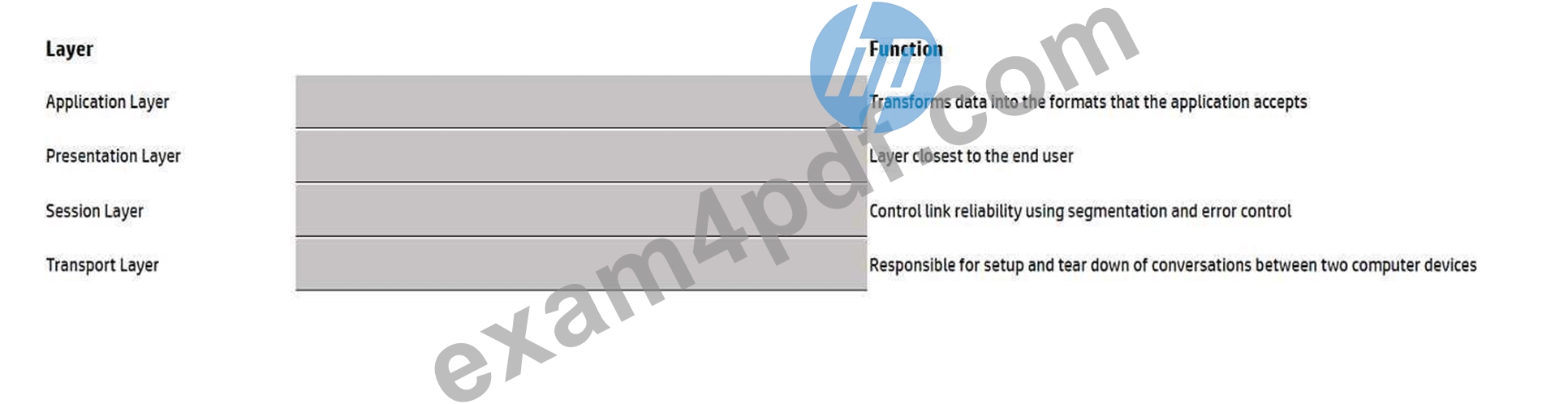
Answer:
Explanation: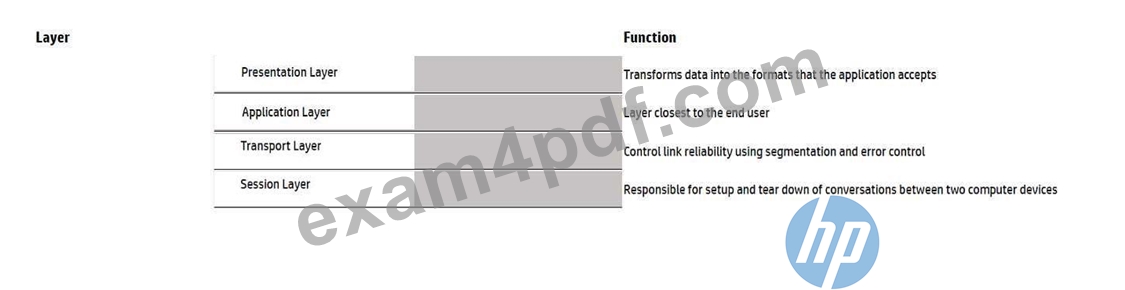
NEW QUESTION # 23
Match the switching technology with the appropriate use case.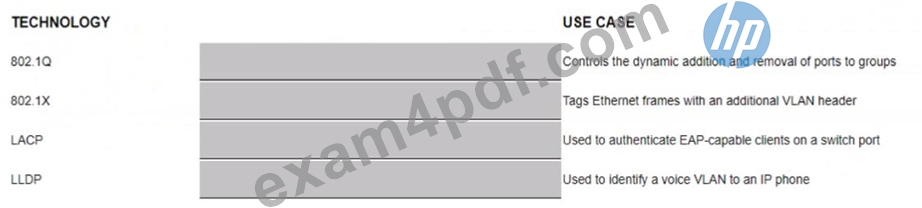
Answer:
Explanation: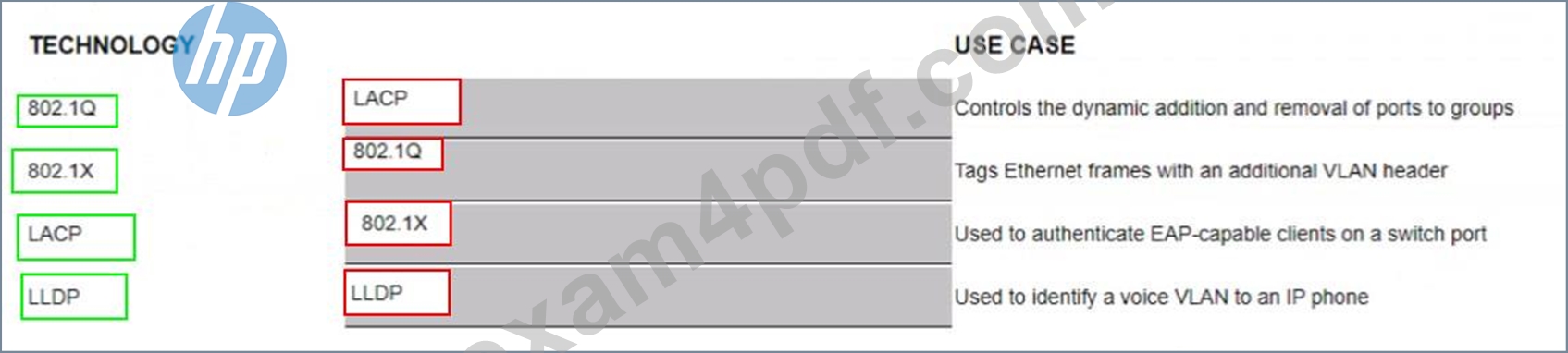
NEW QUESTION # 24
When using the network check page in Central, what kind of tests can you run on switches?
(Select two.)
- A. PoE-check
- B. LED-check.
- C. A full hardware check, including a heavy memory check
- D. Speed test (iperf)
- E. Ping test
Answer: A,E
Explanation:
In Aruba Central's network check page, you can run several diagnostic tests on switches. A ping test is a common utility to check the reachability of a host on an IP network. A Power over Ethernet (PoE) check can help verify the power delivery status to PoE-capable devices. These tests are crucial for ensuring connectivity and power supply to network devices
NEW QUESTION # 25
What is the ideal HPE Aruba Networking access switch for a cost-effective connection to 200-380 clients, printers, and APs per distribution rack?
- A. Aruba CX 6400
- B. Aruba CX 6200
- C. Aruba CX 6000
- D. Aruba CX 6300
Answer: B
Explanation:
The ideal Aruba access switch for a cost-effective connection to 200-380 clients, printers and APs per distribution rack is the Aruba CX 6200. This switch series is a cloud-manageable, stackable access switch series that is ideal for enterprise branch offices and campus networks, as well as SMBs.
The CX 6200 series offers the following benefits:
- Enterprise-class connectivity: The CX 6200 series supports ACLs, robust QoS, and common protocols such as static and Access OSPF routing.
- Power and speed for users and IoT: The CX 6200 series provides built-in 1/10GbE uplinks and
30W to 60W of Class 4 to Class 6 PoE for powering devices such as APs and cameras.
- Scalable growth made simple: The CX 6200 series supports Aruba Virtual Switching Framework (VSF) that allows you to quickly grow your network to eight members in a single stack using high- performance built-in 10G SFP ports.
- Management flexibility: The CX 6200 series supports a choice of management, including cloud- based and on-prem Central, CLI, switch Web GUI and programmability with AOS-CX operating system, and REST APIs.
The other options are not ideal because:
- Aruba CX 6400: This switch series is a high-availability modular switch series that is ideal for versatile edge access to data center deployments. It offers more performance, scalability, and modularity than the CX 6200 series, but it is also more expensive and complex to deploy and manage. It may not be cost- effective for connecting 200-380 clients per distribution rack.
- Aruba CX 6300: This switch series is a layer 3 stackable access and aggregation switch series that offers Smart Rate and High Power PoE. It offers more features and performance than the CX
6200 series, but it is also more expensive and may not be necessary for connecting 200-380 clients per distribution rack.
- Aruba CX 6000: This switch series is a layer 2 access switch series that offers PoE. It offers less features and performance than the CX 6200 series, and it does not support VSF stacking or routing protocols. It may not be sufficient for connecting 200-380 clients per distribution rack.
NEW QUESTION # 26
Refer to the exhibit.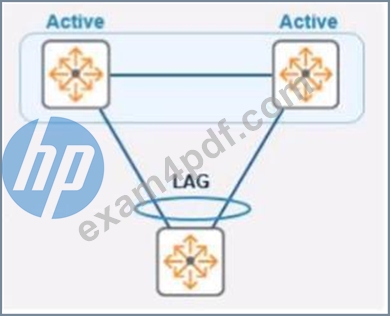
In the given topology, a pair of Aruba CX 8325 switches are in a VSX stack using the active gateway What is the nature and behavior of the Virtual IP for the VSX pair if clients are connected to the access switch using VSX as the default gateway?
- A. Virtual IP uses SVI IP address synced with VSX
- B. Virtual IP is active on the primary VSX switch
Virtual floating IP will failover in case of a failure - C. Virtual IP is active on both CX switches
Answer: B
Explanation:
Explanation
Virtual Switching Extension (VSX) is a feature that allows two Aruba CX switches to operate as a single logical device with a single control plane and data plane. VSX provides high availability, scalability, and simplified management for campus and data center networks3. In VSX, one switch is designated as the primary switch and the other as the secondary switch. The primary switch owns and responds to ARP Address Resolution Protocol. ARP is a communication protocol used for discovering the link layer address, such as a MAC address, associated with a given internet layer address, typically an IPv4 address. This mapping is a critical function in the Internet protocol suite. requests for the virtual IP address of the VSX pair4. The virtual IP address is used as the default gateway for clients connected to the access switch. If the primary switch fails, the secondary switch takes over the virtual IP address and continues to forward traffic for the clients5.
References: 3
https://www.arubanetworks.com/techdocs/AOS-CX_10_04/UG/Content/cx-ug/vsx/vsx-overview.htm 4
https://www.arubanetworks.com/techdocs/AOS-CX_10_04/UG/Content/cx-ug/vsx/vsx-ip-addressing.htm 5
https://www.arubanetworks.com/techdocs/AOS-CX_10_04/UG/Content/cx-ug/vsx/vsx-failover.htm
NEW QUESTION # 27
What does a wireless client do first when its countdown timer reaches zero and it receives a Transmit Opportunity (TXOP)?
- A. It sends a CTS-to-self announcement to the ESP gateway.
- B. It immediately sends its Data Frames and receives an ACK from the AP.
- C. It sends a CTS-to-self announcement to the AP and all other clients.
- D. It sends a reassociation request frame to the AP and sends its Data Frames.
Answer: B
Explanation:
When a wireless client's countdown timer (also known as a backoff timer) reaches zero during contention-based access periods, and it receives a Transmit Opportunity (TXOP), it has the right to transmit its data frames on the medium. After sending the data frames, it expects an acknowledgment (ACK) from the Access Point (AP) to ensure the frames were received successfully.
NEW QUESTION # 28
List the WPA 4-Way Handshake functions in the correct order.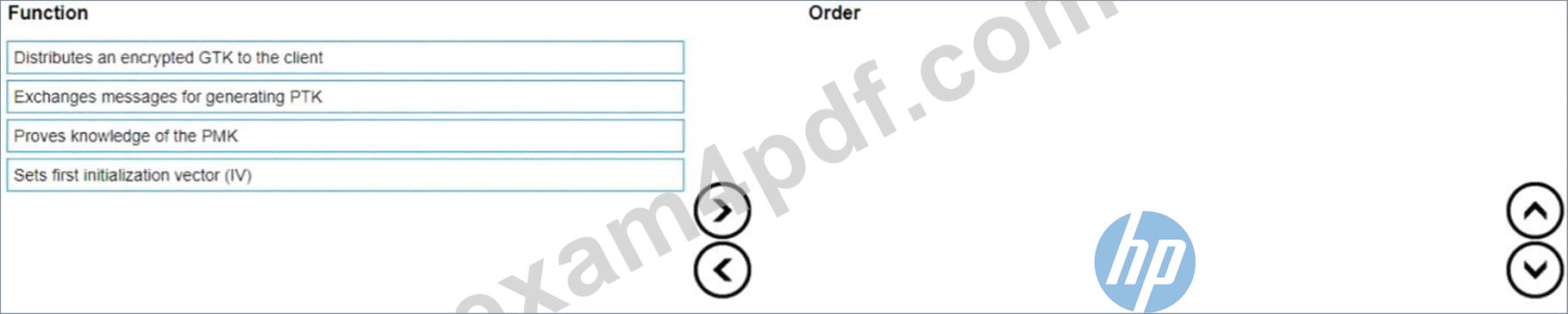
Answer:
Explanation: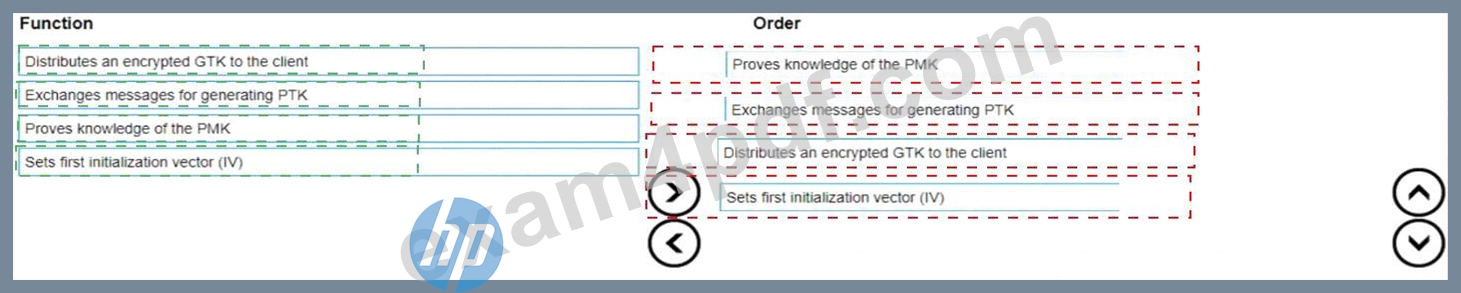
* Proves knowledge of the PMK
* Exchanges messages for generating PTK
* Distributes an encrypted GTK to the client
* Sets first initialization vector (IV)
NEW QUESTION # 29
......
Updated Verified Pass HPE6-A85 Exam - Real Questions and Answers: https://practicetorrent.exam4pdf.com/HPE6-A85-dumps-torrent.html
